What AI-native Means for Commerce Operations
- BootWhoo Team
- AI , Machine Learning , Technology
- 15 Jan, 2024
Commerce operations rarely fit inside a single tool. A customer asking about an order may need an answer informed by inventory, fulfillment status, and the store’s returns policy. A promotion may depend on catalog quality and available stock as much as campaign performance.
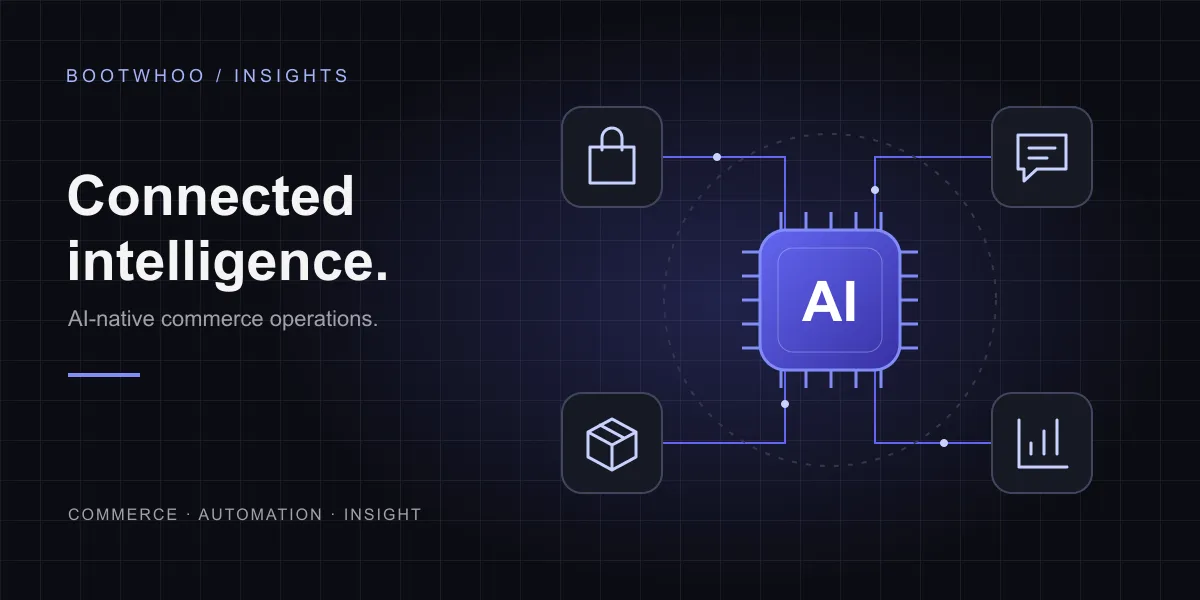
An AI-native commerce operations platform starts with these connected workflows, rather than treating AI as a standalone chat interface. At BootWhoo, that is the focus of our platform and the way we think about the work.
Start with the workflow, not the model
Before choosing what to automate, define the operational problem:
- What event starts the work?
- What business context is needed to make a decision?
- Which actions are allowed, and which need approval?
- Who owns exceptions and the final outcome?
These questions are more useful than a generic promise to automate everything. They make the boundaries of an AI-assisted workflow explicit.
Connect context across commerce operations
Three areas illustrate why context matters:
Customer operations
Order questions, returns inquiries, and product requests need answers grounded in the business’s policies and current information. A useful workflow also recognizes when the customer needs a person, not another automated reply.
Merchandising operations
Catalog updates and promotion decisions should account for storefront signals, inventory constraints, and commercial rules. AI can help teams organize the work and identify what needs attention; the business still owns the decision.
Order and inventory operations
An order exception is not just a status field. It can create work for fulfillment, customer support, and merchandising. Clear ownership and handoffs help teams follow an issue through to resolution.
Build human oversight into the process
An illustrative workflow might gather order context, prepare a response, and route an address-change request for approval before any update is made. The specific steps depend on the business’s systems and policies; this is an example, not a claim about an available integration.
Sensitive decisions deserve explicit boundaries. Define review points for actions involving customer data, payments, refunds, or inventory, and decide how exceptions should reach the responsible team.
Measure the work, not the hype
Start with one bounded workflow. Establish a baseline for handling time, rework, exception volume, or resolution quality. Review what changed and where human intervention was still needed before expanding automation.
There is no universal revenue multiplier or deployment timeline. Outcomes depend on the workflow, data quality, operating rules, and the people responsible for it.
The BootWhoo perspective
BootWhoo is the company behind an AI-native commerce operations platform focused on customer operations, merchandising, and order and inventory workflows. AI agents support that operating approach; they are not the whole product story.
If you are exploring this approach, bring a specific workflow and the systems it touches. Contact our team at [email protected] to discuss fit, scope, and next steps.